Malacology
Malacology is the study of mollusks. This includes animals like octopus, snails, slugs, and clams. It is the second largest phylum of animals, making them one of the most successful groups on the planet. There are over 80,000 described species of mollusks with many more left to be discovered. Mullusca is composed of 8 recognized classes including Cephalopoda, Gastropoda, Polyplacophora, Scaphapoda, Monoplacophorans, the Aplacophorans, Caudofoveata and Solenogastres, and Bivalvia.

Big-Tooth Whitelip
(A. Binney, 1837)
Neohelix dentifera
Class:
Order:
Family:
Gastropoda
Stylommatophora
Polygyridae
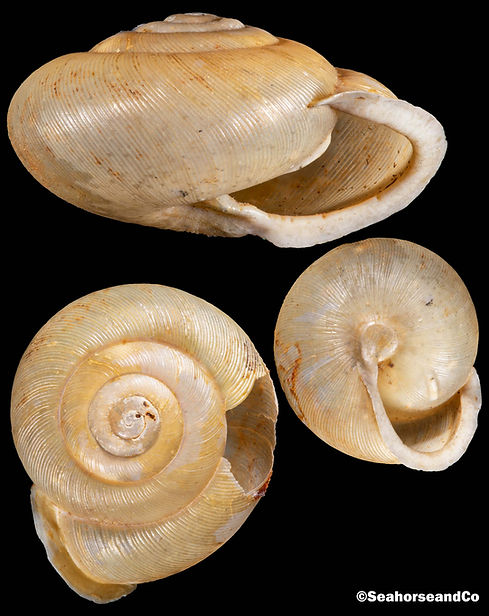
ANSP 449896 [syntype]
Ecological Information
Native/Inavsive:
Native
Nature Serve Conservation Status:
G5: Secure
Median Size:
12.3
Height:
Width:
21.5
Taper:
0.5
Taxonomic Information
Helix dentifera
Original Combination:
dentife = tooth [latin]
Etymology
Original Description:
Animal. Greyish on the sides and posterior extremity, brownish on the upper parts, darker on the head and neck, foor long and narrow, superior tentaculae long and slender, eyes black.
Shell. Flattened, convex on the upper surface, convex below: epidermis, yellowish horn-color, immaculate: spire depressed: whorls, five, with delicate, parrallel, oblique striae: suture, distinct, not deeply impressed: aperture, contracted by the lip, flattend towards the plane of the base; lip white, broadly and abruptly reflected: pillar-lip with a prominent, white, tooth-like proccess nearly parallel with the lower margin of the aperture: base convex.
Greatest transverse diameter about three quarters of an inch.
Geographical Distibution. Noticed by me, hitherto, only in the State of Vermont, on the eastern slope of the Green Mountains.
Remarks. This species, now for the first time described, is not common in the localities which it inhabits. Its distinguishing marks are, its flattened form, and the tooth on the pillar lip.
While observing it with the animal retracted and the callar just visible at the aperture, I have heard a sharp snapping sound emmited, which seems of the respitory foramen; but in what manner it is produced I have not been able to discover. The same is made by H. albolabris, H. thyroidus, and H. diodonta, and is probably common to the genus.
Original Description Citation:
Binney, A. (1837). A monograph of the helices inhabiting the United States. Boston Journal of Natural History. 1(4): 466-495, plates 12-21.

Citations
-
-
-