Malacology
Malacology is the study of mollusks. This includes animals like octopus, snails, slugs, and clams. It is the second largest phylum of animals, making them one of the most successful groups on the planet. There are over 80,000 described species of mollusks with many more left to be discovered. Mullusca is composed of 8 recognized classes including Cephalopoda, Gastropoda, Polyplacophora, Scaphapoda, Monoplacophorans, the Aplacophorans, Caudofoveata and Solenogastres, and Bivalvia.

Florida Chalksnail
Pilsbry, 1905
Succinea floridana
Class:
Order:
Family:
Gastropoda
Stylommatophora
Succineidae
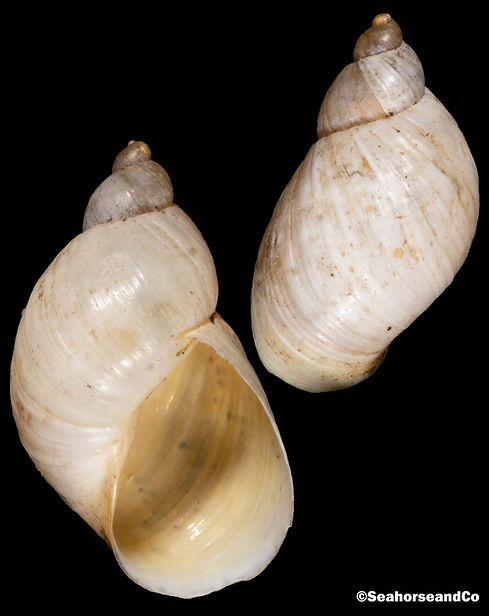
ANSP 87358 [lectotype]
Ecological Information
Native/Inavsive:
Native
Nature Serve Conservation Status:
G2: Imperiled
Median Size:
13.7
Height:
Width:
8.8
Taper:
0.5
Taxonomic Information
Succinea floridana
Original Combination:
Etymology
Original Description:
Shell obesely ovate, thin but strong for the genus, opaque, flesh-tinted or pinkish-white, marked with corneous-fleshy streaks, and usually a few scattered clear dots, readily seen by holding the shell up towards the light; apical whorl usually reddish-brown. Interior more or less deeply tinted with ochre-yellow. Whorls 3 ½ to 3 ¾, very convex, the last whorl evenly convex. Sculpture of. fine, unequal growth-lines and coarse but low wrinkles, with some indistinct malleation on the last whorl. Aperture ovate, short; outer lip well arched; columella oblique and nearly straight.
Length 12.3, diam. 7.2, length of aperture 8 mm.
Length 12.2, diam. 7, length of aperture 7.8 mm.
Length 12.8, diam. 7, length of aperture 8 mm.
Northern end of Big Pine Key, abundant in long grass, types no. 87358 A. N. S. P., collected by Messrs. Fowler and Brown, June, 1904. Other localities are Summerland Key, Cudjoe Key, Sugarloaf Key, Boca Chica Key, Key West. On the mainland and keys of west Florida at Blue Hill Island, near Goodland Point (C. B. Moore), and one mile east of Marianna, Chipola river (C. W. Johnson, 1900, one bleached specimen).
This species has hitherto been considered a form of S. luteola, from which it differs in the much shorter contour and more convex last whorl. I have seen no specimens from Florida referable to luteola. S. floridana is also closely related to S. campestris, which is still more obese, and more strongly corrugated, with the spire less slender. The most nearly related forms are, however, the Antillean S. ochracina Gundl. of eastern Cuba and S. dominicensis Pfr. Of Santo Domingo. In both of these, however, the color is more lemon than ochre-yellow. S. dominicensis is a smoother, white and very beautiful shell. S. ochracina is somewhat rough, streaked white and corneous with a pale lemon tint throughout, and with a longer aperture than S. floridana.
S. floridana varies a good deal in size. The largest seen is from Key West, 14 mm. long, and the smallest adults are from Boca Chica Key, 8 ½ mm. long, with 3 ½ whorls.
Original Description Citation:
Pilsbry, H. A. (1905). Land shells of the Florida Keys. The Nautilus. 19(4): 37-41.

Citations
-
-
-