Malacology
Malacology is the study of mollusks. This includes animals like octopus, snails, slugs, and clams. It is the second largest phylum of animals, making them one of the most successful groups on the planet. There are over 80,000 described species of mollusks with many more left to be discovered. Mullusca is composed of 8 recognized classes including Cephalopoda, Gastropoda, Polyplacophora, Scaphapoda, Monoplacophorans, the Aplacophorans, Caudofoveata and Solenogastres, and Bivalvia.

Our website is moving to TheNaturalistProject.com!
Check out the new website here:
Talladega Slitmouth
(G. H. Clapp, 1907)
Stenotrema brevipila
Class:
Order:
Family:
Gastropoda
Stylommatophora
Polygyridae
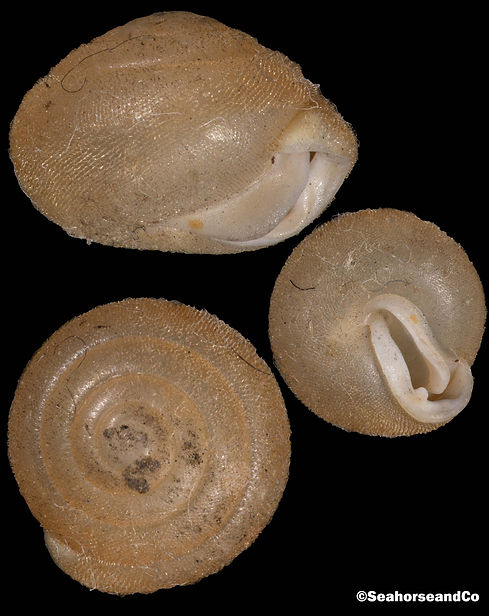
ANSP 92758 [cotype]
Ecological Information
Native/Inavsive:
Native
Nature Serve Conservation Status:
G2: Imperiled
Median Size:
Height:
Width:
Taper:
Taxonomic Information
Polygyra (Stenotrema) brevipila
Original Combination:
Etymology
Original Description:
Shell imperforate, globose, thin, light reddish-horn color; densely hirsute with fine, short hairs. Whorls five, those of the spire convex with a well-impressed suture; the body-whorl very convex, equally rounded above and below, deeply impressed in the umbilical region, abruptly deflected at the aperture and contracted behind the lip. Aperture transverse, narrow, widening anteriorly; parietal tooth large, strong but narrow, erect, with the sides nearly at right angles to the whorl and projecting beyond the lip, with which it is not parallel, but diverges for three-fourths of its length, when it is abruptly bent inward and downward, terminating opposite the second notch in the lip, its distal or outer extremity connected with the end of the peristome by a ridge of callus, the axial end sweeping around and "pocketing" the basal end of the lip ; outer lip reflected back against the body-whorl, but with its sharp edge free from the whorl its entire length; very much thickened along its inner edge which forms a raised margin around the wide notch, and a well-developed tooth or fold beyond it, after which the margin is incurved around the outer extremity of the parietal tooth. Fulcrum long.
An average shell measures, diam. 8 ½, alt. 6 mm.
The largest seen measures 9 x 6, and the smallest 7 ¾ x 5 ¾ mm.
Collected by Herbert H. Smith on Horseblock Mountain, Talladega Co., Ala., at an altitude of about 2,000 feet. On some of the U. S. Geological Survey sheets this mountain is called "Talladega," but "Horseblock" is the local name.
"The mountain sides, near the top, are littered, or rather piled with talus, big and little rocks ; the shells are found almost invariably on the lower sides of these rocks, and generally they chose the biggest and heaviest; you turn over perhaps fifty to find one shell. They are obtained by sheer hard work." H. H. S.
This is one of the most striking species of the Stenotrema hirsute group, and differs from all others in having a continuous free lip; the lip-notch is also of an entirely different type, as it will be noticed by a reference to the figures that the notch is not an indentation in the center of the lip, but the lip forms a curve from the columellar end to the highest part of the notch when it is suddenly deflected and bent forward. The parietal tooth differs in being more perpendicular to the body-whorl, not bent toward the Up, as in Stenotrema, where the tooth is very convex on its outer side and concave on the side next the lip, which it frequently overhangs. On looking into the aperture, through the notch, the whole of the long fulcrum can be plainly seen.
The only species with which this is likely to be confused is P. altispira Pils., but the resemblance, due to the wide notch in each case, is only superficial; for, as pointed out above, the notch is of a different type. The hairs are also much finer, closer and shorter, and the shape of the shell is entirely different.
Type in my collection ; cotypes in the collections of the Academy of Natural Sciences, Phila., Bryant Walker, T, H. Aldrich and John B. Henderson, Jr.
Original Description Citation:
Clapp, G. H. (1907). New species of Stenotrema and Paravitrea from Alabama. The Nautilus. 20(10): 109-111, pl. 5.

Citations
-
-
-